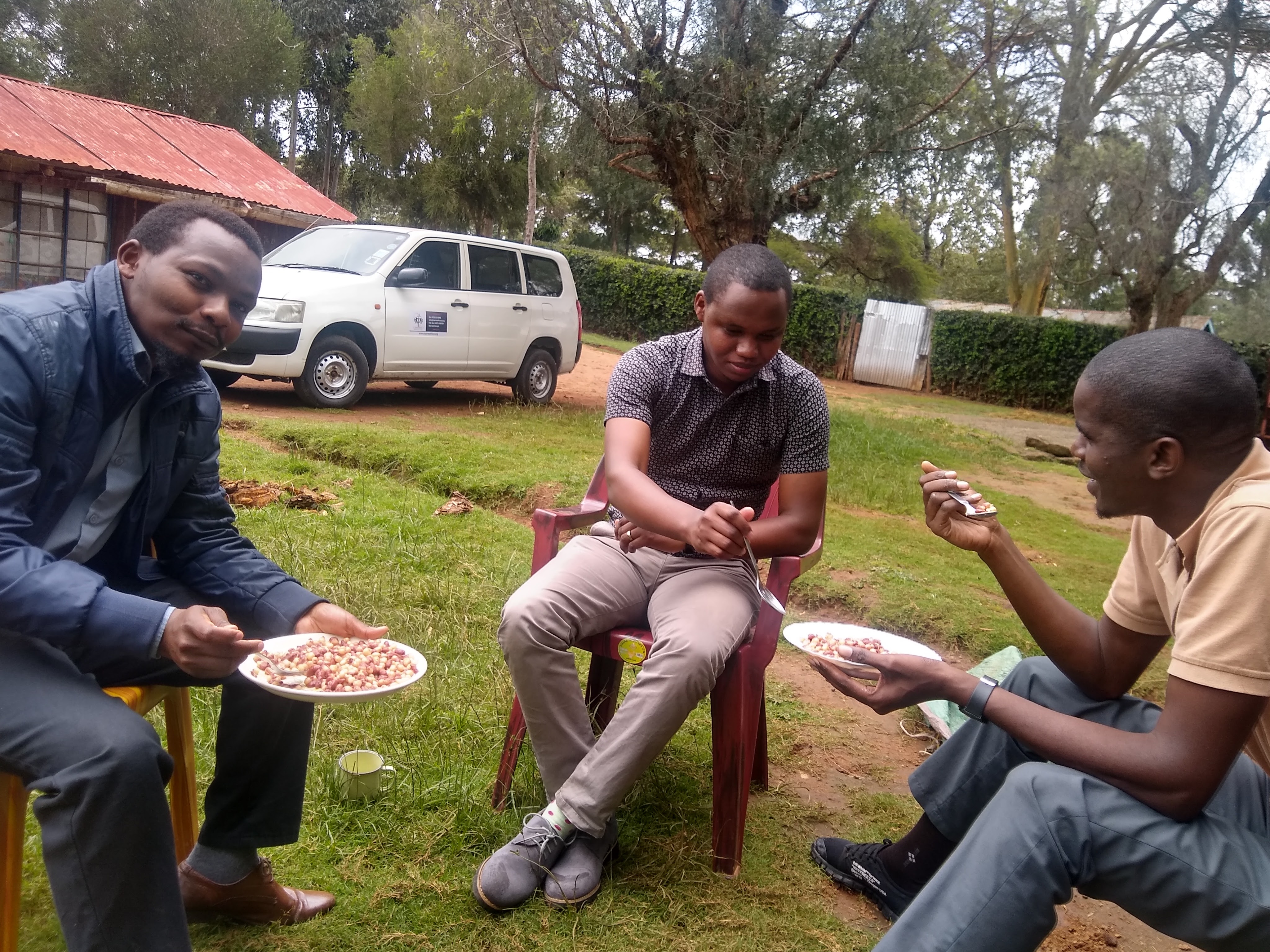
Hope for the Discouraged

GracePoint Church, Kikuyu.  Sermon – 30th March 2025

Passage: 1 Kings 19: 1- 21.

Big Idea: God’s people find their hope in God through the hard seasons of life in God’s  gracious provisions of prayer, rest, His word and His work.  

Introduction: The journey of the believer is full of many difficulties. Pain and suffering is the daily experience of those who follow Christ. Indeed, we might be living out John 16:33 which  says – in this world you will have many sorrows.  As we are gathered here this morning it may well be that you are going through particularly hard times. For some it may be grief – indeed, some among us have known the pain of losing loved ones in the recent past. For others, it may be anxiety about the future – things don’t seem to be working out as we had hoped or planned and you are beginning to feel stuck and not making progress. For others, it may be the pain of betrayal – from friends, family or significant others in our lives – let down by those that you may have confided in – deep pain as you watch a relationship you have really struggled for, crumble before your very eyes. For others the pain is physical – sickness in your body or in your wider family. Perhaps you have a patient to look after at the end of this service. Pain and suffering seems to be our daily reality – from frustration at work to difficulties in marriage, parenting, the list could go on and on. The question then is – what resources do you have for the hard times? Where do you draw strength when the times are tough? 

The passage we are looking at today shows us a different side of Elijah. From the man who was praying fervently and stopping the rains, raising the dead, contesting with the prophets of Baal and calling fire from heaven, to having rain restored in the land. Now we see a man who is running away – afraid of Jezebel and giving up on life and ministry. Let us follow the story and draw out the lessons that this passage has for us this morning. We shall do that in four sections: 

  1. Fight, Flight or Freeze: Ahab reports to Jezebel about the great slaughter of her priests and she fumes, issuing death threats on Elijah: Then Jezebel sent a messenger to Elijah, saying, “So may the gods do to me and more also, if I do not make your life as the life of one of them by this time tomorrow.” I am not sure what your reaction would be if you received a death warrant within 24 hours from Jezebel. You see, you would have thought that Elijah would be celebrated in Israel, especially after that heavy rain but no. He is now a wanted fugitive who must run for dear life. Verse 3 gives us his response: Then he was afraid, and he arose and ran for his life and came to Beersheba, which belongs to Judah, and left his servant there. The great prophet Elijah is afraid. Friends – even the best among us is, at best, a man (human), subject to fear and natural responses to threats – fight, flee or freeze. 

Dear saint, watch your perspective. There is so much talk about being brave, that many are ashamed when they are afraid. We need to have a right perspective of ourselves – Psalm 103: 14 tells us that we are like dust, like a flower of the field. We are small, weak and often lacking in wisdom. We are going through bereavement in the church family at the moment and one of the things that death reminds us is our own mortality.  Psalm 56:3 talks of ‘when I am afraid’ – we are those who get afraid -the question is – where do we look when we are afraid. 

2. Desperate plea. The prophet is now on the run for his life. Yet it is worth noting that he ran to Beersheba – a historically significant location which was in Judah. A journey of about 160 KMs. Elijah leaves his servant behind and goes further into isolation – takes a day’s journey into the wilderness and sits down under a broom tree. He seems to have come to the lowest point in his ministry and asks that he might die. “It is enough; now, O Lord, take away my life, for I am no better than my fathers.” Here is a man who seems to have come to the end of the road. He feels that his contribution does not matter – his ministry did not turn people from idols and now he is running for his life.  And here he is laying bare his raw emotions before God. 

Dear Saint: Run to the Lord in prayer. Our father can handle your frustration, he listens to our desperate pleas and even our less than wise prayers. You see, prayer is one the means of grace that God has given us in our journey. We can come to the Lord and let him know all about our difficulties, we can lay down our burdens, our fears and shortcomings before him.  Think of the words of Irish Hymn writer Joseph Scriven’s song: What a friend we have in Jesus. 

Have we trials and temptations?  Is there trouble anywhere?
We should never be discouraged;  take it to the Lord in prayer!
Can we find a friend so faithful,  who will all our sorrows share?
Jesus knows our every weakness;  take it to the Lord in prayer!

Are we weak and heavy laden,  cumbered with a load of care?
Precious Savior, still our refuge-  take it to the Lord in prayer!
Do thy friends despise, forsake you? Take it to the Lord in prayer!
In his arms he’ll take and shield you; thou will find a solace there.

3.  Practical Help. What happens after that is worth our notice;  He falls asleep under the broom tree.  An angel wakes him up to eat: bread and water – which seems to have been his favorite food. He sleeps again, we are not told for how long. The angel wakes him to eat again and reminds him the journey ahead is too much for him.  He woke up on the strength of that meal and  went to Horeb (Sinai), the mountain of God, a journey of 40 days. 

Providentially, there was a broom tree under which Elijah rested and then fell asleep. Here is a man who had come from an intense contest with false prophets and is now on the run. He desperately needed to rest. Twice in this section he will fall asleep. You see, sleep reminds us of our weakness – we can’t keep going on and on forever (don’t believe that Energizer bunny advert or that Red Bull advert). We need to pause, stop and recharge our batteries. 

Brothers and sisters – let us prioritize good, quality sleep. We are living in stressful times and to make it worse, we are not sleeping well. We are a distracted lot – the enemy has kept us busy and distracted from the things that truly matter. Yet one of the means of refreshment and renewal that our father has graciously given us is sleep (Psalm 127: 2) A lot of what people are calling mental health difficulties nowadays (and I am not minimizing any of it), has been shown to be dealt with by good, quality sleep. The first thing they do to any mental health patient is to get them to sleep.  I  pray that we can be those who organize our personal, church, social and family life in such a way that we have the opportunity for good quality sleep every night. 

Secondly, you will notice that the angel gives him food. Behold, a cake baked on hot coals and a jar of water. Just what he needed after such a long journey. Elijah seemed to enjoy his bread ( we know that from his encounter with the ravens and his request to the widow of Zarephath) and now, far south in the desert, an angel has brought him bread and water. This is repeated again and he gains strength for a 40 day journey in the wilderness. The man is now revived and ready to go to Horeb, the mountain of God. 

Dear Saint, praise God for good food. It seems what the man of God needed at this point is a good meal and he will be good to go. A lot of ministry – I have found, tends to be around food. Food reminds us of our father’s provision, connects us together when we share together as a family or with friends and refreshes us. We must however stay away from the extremes of too much to eat (gluttony) or too little (anorexia) and receive food/drinks in moderation and with thanksgiving in our hearts. 

4. The Lord speaks. Elijah comes to a Cave in Mt. Horeb and behold: the word of the Lord came to him, and he said to him, “What are you doing here, Elijah?” In other words, why are you here? His answer, which he repeats in verse 10 and 14 speaks of the anguish in his soul – “I have been very jealous for the Lord, the God of hosts. For the people of Israel have forsaken your covenant, thrown down your altars, and killed your prophets with the sword, and I, even I only, am left, and they seek my life, to take it away.”  He feels alone, burned out and threatened.  

The Lord asks him to stand on the Mount before him and there follows three signs – great and strong wind, earthquake and fire but the Lord was not in any of those. This was then followed by a voice of a low whisper – still small voice (KJV) and the Lord asks him – what are you doing here Elijah? He repeats his answer and instead of correction or judgement he is sent back to work: Return on your way to the wilderness of Damascus – anoint two kings and get an assistant. Through this, he is reminded that there will be judgement for idol worshippers, and that there are many who have not worshipped Baal. Elijah, in obedience to God’s word leaves the mountain, returns to the north and calls Elisha to follow him. 

Dear Saint, Listen to God’s Word. You see, God spoke to Elijah even in that moment of doubt and despair. He calls him to Horeb, a significant place where God gave His word to Moses and speaks to him in a still small voice. Allow me to observe that it is easy to think that we are hearing God’s voice when we see miraculous demonstrations of wind, earthquake and fire –  he can and he has used such means before – but on this occasion he used the sound of a low whisper. Ordinary, conversation level whisper is what is ministered to Elijah, all the way in Horeb. And what did the Lord say to him? Go back to your mission – you are a prophet. Anoint two kings and a prophet to continue your ministry. The Lord ministers hope through His word. 

You see, God has given us his word to equip us for the journey ahead. We do not have to look down in shame or sorrow, we do not have to look inwards for an inner voice but we can look upwards and pay attention to God’s word. Listen to what Apostle in 2 Peter 1:16-21; 

For we did not follow cleverly devised myths when we made known to you the power and coming of our Lord Jesus Christ, but we were eyewitnesses of his majesty. For when he received honor and glory from God the Father, and the voice was borne to him by the Majestic Glory, “This is my beloved Son, with whom I am well pleased,” we ourselves heard this very voice borne from heaven, for we were with him on the holy mountain. And we have the prophetic word more fully confirmed, to which you will do well to pay attention as to a lamp shining in a dark place, until the day dawns and the morning star rises in your hearts, knowing this first of all, that no prophecy of Scripture comes from someone’s own interpretation.  For no prophecy was ever produced by the will of man, but men spoke from God as they were carried along by the Holy Spirit.

And this word, equips us for God’s work. You see, Elijah is not sent to terminal leave but actually back to the field. He is sent right back into the field and as we will see in the coming chapters, the work continues. You see God has ordained work as the means through which he would give us purpose (meaning) and provision for our daily bread. Jesus said in John 9:4   We must work the works of him who sent me while it is day; night is coming, when no one can work.”

Dear Saint, Go back to work. Brother and sisters, we must continue working and delighting in our labours. Part of the reason many of us are anxious is just that we are not doing productive work – and by productive I don’t mean financially profitable but all work, done to the glory of God. Work is good and was ordained before the fall. So get back to work tomorrow – with a spring in your step, the Lord has called you to that office or business or home to serve his purpose – for your good and to His glory. 

Conclusion: So we close today’s sermon where we started – what resources do you have for the hard times? Where are you looking when the going gets tough? 

Our gracious father has given us means of grace to help us in our times of need. He has given us Prayer, Rest/Refreshment, His word (the gospel) and His work. And we ought delight in these things together as a community. We have each other brothers and sisters – you don’t have to face it all alone, reach out to a friend, reach out to one another, seek audience with the elders of the church, pray,  get some sleep, get some food, get some assistant, listen and obey God’s word to continue in His work. The work is the Lord’s and it will continue well beyond your time and mine. 

“I have said these things to you, that in me you may have peace. In the world you will have tribulation. But take heart; I have overcome the world.” John 16: 33

In the name of the Father, the Son and the Holy Spirit.  

Harrison Mungai M

Got Questions/Comments on this sermon? Engage further with me on my blog: www.mungaimacharia.com 

Reflections on Lausanne 4

I spent the last week of September in Seoul Incheon, South Korea attending the Fourth Congress on World Evangelization popularly known as Lausanne 4. This was a historic gathering that marked 50 years since the birth of the Lausanne movement.  The first congress in 1974 in Lausanne, Switzerland gave the movement its name and brought together 2700 delegates from over 150 countries. They affirmed their conviction that the whole church must take the whole gospel to the whole world in the first document – the Lausanne covenant. Lausanne 4 brought together more than 5200 leaders from nearly every country in the world with the clarion call ‘Let the church declare and display Christ Together

Lausanne has had an impact over the years in rallying the church to accelerate global evangelization resulting in millions in previously unreached regions embracing the gospel. Lausanne 4 marked a significant moment in the global Christian community’s ongoing commitment to evangelism and mission work. Here are some reflections

1. A bold vision

The clarion call of Lausanne 4 was “Let the church declare and display Christ Together.” This encapsulated the congress vision of the Christians in a polycentric world working together collaboratively to fulfill the great commission. This seems to have come from a realization that there are diverse people, cultures, ministry expressions and even theological differences yet everybody influenced by the wider Lausanne movement would agree on the primacy of evangelism and that the best way to do this is by working together. I found the call noble in its intention and grand in its ambition. If well pursued, it would lead to greater impact as there would be less and less duplication of effort. Yet therein lies the greatest challenge – how to actually make it happen. Towards the end of the event participants were invited to sign a Collaborative Action Commitment so as to build deeper relationships and explore opportunities for synergy and collaboration. I found that effort helpful especially in making the commitment personal and calling the leaders to intentionally respond to the great commission by filling gaps and seizing opportunities towards its fulfillment. I was challenged to remove duplication and silos by celebrating others and collaborating with them to address challenges facing the global church.

 2. A broad vision

With participants from nearly every country on earth, the congress showcased the rich tapestry of global Christianity. This diversity fostered cross-cultural dialogue and collaboration, allowing attendees to share unique insights and strategies relevant to their contexts. The movement had stated that the congress will be ‘catalytic in advancing the Movement’s fourfold vision — the gospel for every person, disciple-making churches for every people and place, Christ-like leaders for every church and sector, and kingdom impact in every sphere of society.” Indeed, true to that vision there were many issues at hand for discussion. Lausanne had identified 28 ‘gaps’ ranging from creation care, church planting, polycentric resource mobilization, children at risk etc. All these are good things and indeed worthy of attention by the global Christian community. However, one wonders if it is possible to hit all those balls in one conference or by one movement.  Maybe like the body with many parts some will be drawn to certain aspects of mission and others by different ones. Lausanne helped me to be generous in my attitude towards those particularly keen on areas I might be paying less attention to.

3. A monumental task

The size of the congress and the variety of issues pointed to one reality – the task ahead is big and that we are small. It almost appeared as if the more we work the more the work increases. Yet Lausanne had done a thorough job in releasing the state of great commission report which outlined the key gaps in mission that need to be addressed urgently. Some of these include the next generation (Gen Z), use and stewardship of technology, issues of justice and poverty, persecution and workplace ministry and many more. The congress helped to show that we are living in a complex world that is constantly changing and yet the unchanging gospel message needs to be communicated and heard by all. This led me to think that the advance of the gospel will call for recognition of our weakness, smallness and vulnerability. This would in turn inspire us to prayer, collaboration and faithful stewardship. Two particularly insightful takeaways from the issue network I was part of were the call to thinking digital and relationships. We are in a super-interconnected world and ministry going forward will increasingly look digital yet, ironically the craving for authentic human relationship will also be there. 

Whereas it was beautiful to see the global church gathered and so many cultural expressions of worship, the reality of the task ahead was not lost on us.  Throughout the congress, there were times for prayer and reflection integrated into the programme. Participants were encouraged to seek God’s guidance for their ministries and the global church’s mission. These moments of prayer were special in highlighting the importance of relying on God in His mission.

 Conclusion

The Lausanne 4 Congress on World Evangelization served as a critical gathering for the global church, reinforcing the importance of collaboration in mission. At a time when the global church is divided on so many issues, it was refreshing to hear that clarion call towards unity and collaboration. I appreciated being together with more than five thousand others, all united under one great story – the gospel.That in itself was really encouraging and challenging at the same time.  I appreciated the call to build bridges of collaboration rather than silos of isolation – I needed that reminder that my theological or ecclesiastical tribe is not the gospel and that there are others out there serving the Lord albeit somewhat differently from me. I was humbled by the call on the very first night of the congress towards repentance, I was rebuked of the pride in thinking that ‘I don’t need you’ and invited to extend a right hand of fellowship to others and do the hard work of building bridges. I appreciated the clear portrait of the world we live in that was painted at the congress – that there are many areas I might not be paying sufficient attention to and yet those might be critical points of mission. There are certainly issues that I wish were given more prominence such as the primacy of the local church and perhaps more clarity on the gospel itself but for what it is worth, Lausanne 4 was a good wake up call for the body of Christ to declare and display Christ Together.

Predestination

The first time I heard the phrase ‘doctrines of grace’ I was training for ministry in a local church and I did not understand the meaning of that phrase. I had heard the term ‘predestination’ before but it was in a mocking sense – those people who say that the graph of your life has already been drawn. Although I had been saved for a long time, I had not realised that that scripture reveals to us how God has chosen to call a people to himself through our Lord and saviour Jesus Christ. Part of it was because I was not hearing it being preached in a local church and so, like most people at the time, my theology (knowledge of God and His word) was being shaped by ideas I picked from books, individuals and conferences I attended where I could not hold those teachers to account. Instead of predestination being a subject of endless theological debates, we can be helped by simply looking at what the Bible reveals about God’s sovereign choice in calling people to Himself.

Drawing from Paul’s letter to Ephesians Chapter 1, the term predestination then refers to God’s sovereign choice before creation of the world, to save people from eternal condemnation by adopting them into His family. This is the spiritual blessing in Christ that Paul shows us in Chapter 1. Paul shows us that God has;

  1. Chosen those that he would save before the foundation of the world to be holy and blameless before him. Verse 4. In eternity past, God chose those whom he would save in Christ.
  2. Predestined in love those that he would save for adoption as sons through Jesus Christ. Verse 5. The term predestined here means that he specifically called people to be his own, entirely out his love so that those he chose, would be adopted into His family.
  3. Chosen according to the purpose of His will to the praise of His glorious grace. Verse 6. This sovereign choice is entirely by God’s will (not foreknown decision) and it is meant to serve His glory.

Consequently, those who are in Christ have;

  1. Been redeemed. They have been rescued from God’s judgement and condemnation and have been forgiven of their sins entirely by God’s grace. Verse 7.
  2. Have had their eyes opened to see the mystery of His will for then in Christ. Verse 8 -9.
  3. Been united with Christ Verse 10. They have been made one in the family of God.
  4. Received an inheritance Verse 11. They have the greatest treasure imaginable to man.
  5. Are to live to the praise of His glory. Verse 12. The whole point of their predestination is so that they can live to the to the praise and honour of God who has redeemed them.

Practical Purpose of the Doctrine of Predestination

  1. It affirms God as the only writer of the salvation story and hence deserving of all praise and glory for our salvation.  Verse 1
  2. It leads to humility. Since salvation is entirely the work of God, believers have nothing to boast about. Predestination checks against human pride. Eph 2:8-9, James 4:13 -15.
  3. It speaks to assurance of salvation -verse 4.  Since our father has chosen those He will save, it follows that He will hold them fast and bring them to their eternal home. He who began the work in them before the creation of the world, will bring it to completion.
  4. Predestination fuels prayer. Since salavtion entirely depends on God, believers can call upon Him who had ordained prayer and depend on Him who is the ruler of all things. We can pray for those who are lost in sin for salvation belongs to our God (Jonah 2:9)
  5. Motivation for Evangelism (John 10:16). The Lord has many other people who are His but they are lost in the world. We can be motivated to reach out to them since, His sheep hear His voice and they will respond to the voice of the shepherd. The Lord has ordained evangelism as the means to that the end.
  6. Spiritual maturity/perseverance in the knowledge that whatever God ordains is right. (Ps 39). When we know that God has ordered, not just our salvation but all events in life, we can be more confident in facing life situations – good and bad. We can rest in His sovereignty in the confidence that whatever He ordains for us is right.
  7. Trust and obedience as instruments of praise (verse 12). Since God has a clear purpose in election, believers can be encouraged to live lives worthy of the gospel as instruments of God’s glory.

May the Lord help us to take God at His word and trust His goodness at all times.

Real Faith, Real Ministry, Real Fruit.

I saw a meme this past holiday that was meant to warn children who were going to the rural homesnot to play carelessly with animals. In the short video, a young man is seen playing a head butting game with a sheep which, characteristic of sheep, steps back and gives the young man a serious head butt. The caption on the video is ‘things are real’. I think reality does not hit us in easy times, but when pain, hard work, difficulty sets in things become ‘very real’.   In Christian life however, the faith is very real no matter where you are. Romans 12 shows us this reality by calling believers to sacrificially demonstrate real faith, real service and real fruit.

Real Faith.

“Therefore, I urge you, brothers and sisters, in view of God’s mercy, to offer your bodies as a living sacrifice, holy and pleasing to God—this is your true and proper worship. Do not conform to the pattern of this world, but be transformed by the renewing of your mind. Then you will be able to test and approve what God’s will is—his good, pleasing and perfect will.” Romans 12:1-2 (NIV) 

Paul shows Roman Christians that they are to be like an offering on an altar – a body given up to flames like a burnt offering on an OT altar. Their bodies are to be a living sacrifice – holy and acceptable to God, for this is their true act of worship. No longer then are they to be conformed to the patterns of this world but are to be transformed by the renewing of minds so that they may discern (and consequently do) the will of God is – the good, perfect and acceptable will.  Like the Romans, real faith in Christ will be demonstrated in true sacrificial living. There is a sense in which our lives will be abandoned at God’s altar. For this is our true act of spiritual worship. We are no longer to conform to worldly patterns but to be transformed by the renewing of our minds.

 Real Ministry 

Paul moves on to tell the Romans that God has given them gifts such as faith, belonging in the body (church family) and ministries to serve in. Each of these gifts are to be deployed in a particular way to serve the wider
body – let us use them he says in verse 6b. The one with prophecy (proclaiming the gospel) in proportion to faith, service, teaching and exhortation, contribution with generosity, leadership (administration) with
zeal, Acts of mercy with cheerfulness.  
Gifts are not for showing off but for showing up

Like one body, the many parts are for serving the Lord and one another.

Real Gospel Fruit

The next section then details what living in faith looks like. It is easy to imagine that fruit is only seen in others but here, Paul shows us that fruit will first need to be seen in the believer. What does a life lived as a living sacrifice look like?  We shall divide up these marks into 3 categories – Heart issues, which mainly address our attitudes, Head issues which mainly address our reasons and Hand issues which mainly address our call to action.

Heart (Verse 9- 15)

  1. Genuine love. Abhors (hates) evil and holds fast to what is good. (v9-10). We are to love one another with brotherly affection and showing honour.
  2. Sincere Joy. Rejoice in hope, (v12) rejoice with those who rejoice
  3. Sincere fellowship with others in the body. Weep with those who weep. (v15)
  4. Patient in tribulation.
  5. Persistent in prayer
  6. Overcoming evil with good (v21). Blessing those who persecute us not cursing. (v14)

Q: How genuine is your love for the brethren? What might you need to work on in 2024?

Head (Verse 16 – 18)

  • Harmony in peace with all men, as far as it depends on us. (v16,18)
  • Humility.  Not haughty (proud) but rather associate with the lowly. (v 16b). Not wise in own sight. (conceited). We listen to the counsel.
  • Honorable. We are not repay evil for evil but give thought to what is honorable in the sight of all. We are not to avenge for ourselves but leave vengeance to God.

Q: How well is your mind renewed by the gospel? What might you need to turn away from and leave behind in 2023? Please write down 2 -3 areas that you need the Lord to help you in 2024.

Hands (Verse 11, 13)

  • Zealous– Do not be slothful but be fervent in spirit – serve the Lord. (v11)
  • Generous. Contribute to the needs of the saints and seek to show hospitality. (v13).

Application Questions: How zealous are your hands for the Lord’s work. Are there areas where you may have been slothful in 2023? How different will be this year be? Please write down 2 -3 areas where you might need the Lord to help you to do more of or less of next year.

Conclusion

Paul concludes in v 21 by stating that we are not to be overcome by evil but rather to overcome evil with good. We live in a broken world and, 2024 will be marked by brokenness, sin and difficulty. Our call then is to consistently demonstrate a real faith, in a real ministry with real fruit.

What Did You Expect?

A joke is told of a pastor who was asked what he does for much of the week since he only preaches one sermon on Sunday and the questioner thought surely there must be other things that the pastor does between Monday and Saturday. The pastor’s answer was straight and to the point: panicking.

There is no doubt that ministry is tough. A lot of times folk in ‘full time ministry’ can be heard moaning about the difficulties of the work – the lack of fruit, decreasing numbers, diminishing incomes, tight budgets, admin workload, relational difficulties (the people aspect of ministry – which is like 90% of the work, is what I personally find very difficult), etc. All these and more make ministry quite a tough undertaking.

However, the same can be said of every area of work. Salesmanship is demanding. Teaching in a school is daunting. Nursing is exhausting. Running a business is walking a tightrope. Academia literally wears the mind. So in reality there is nothing special about ‘full time ministry’ that warrants all the moaning. A friend rebuked us in a retreat recently with the obvious question: what did you expect?  

I was recently preparing to preach from Hebrews 11 and one of the things that stand out in the second half of the chapter is the kind of journey that the men and women of faith listed walked. Yet they were not all in ‘full time ministry’ as the term is understood by many today. This is important for us to understand because the call to Christ is greater that any call to his service. The saints in Hebrews 11 were ordinary men and women in all kinds of trades and vocations – farmers, military men, shepherds and even ‘guys from the hood’ like Jephthah. And although they are commended as men and women of faith it was not easy for them. In reality, their faith looked like…

  1. Costly obedience.  v17 -19.  Abraham left his homeland to a land he knew not. He was asked to sacrifice his son Isaac and was willing to do it, clearly demonstrating where his heart truly was. Everyone called to follow Christ will surely find the call to discipleship costly.
  2. Hope beyond death. The eyes of those OT saints were well set on the things above. They lopked forward to a city whose designer and builder was God. They essentially lost a taste for this earth and developed a deep longing for heaven. Because of our hope beyond death, we are called live as those whose eyes are set on things above (Col 3:2). We know that we are not yet home and so we are to live as those who look forward to eternity.
  3. Self-denial. Moses gave up the pleasures of Egyptian royalty for ‘he considered the reproach of Christ greater than the pleasures of Egypt’. Followers of Jesus will on many occasions need to make costly decisions which will call for self-denial.
  4. Courageous Conflict. For the OT saints listed above like Barak, Gideon, Samson and Jephthah responding to the call of God meant conflict – going into real battle ground. This calls for courage in the face of conflict. The call to Christ is not dissimilar, indeed the path of discipleship is a path of conflict and Christian soldiers are matching daily as to war. As we take a stand for the things that we are convinced by scripture to be true – like marriage being between one man and one woman or the equality of men and women and the dignity of all people. It will mean costly invasions as we raid enemy territory to proclaim the gospel and call others to faith. We are not a ‘live and let live’ kind of people. On the contrary we are often on the offensive.
  • Pain and persecution (v35 -38). Captured in this last verses of the chapter is a vivid description of the state of believers. The writer of Hebrews says that they suffered mocking and flogging, chains and imprisonment, stoning and others chained into two. Some commentators have said that this perhaps alludes to how the apostles of the Lord died but we are not told exactly. We do not have definitive accounts in history but certainly many died a martyr’s death. We cannot expect any less dear saints. We will be mocked on social media and hated in family gatherings, we will be rejected in the society and made to suffer for our faith in Christ. The world indeed was not worthy of them and it is not for us. for ‘whoever would follow Christ, must take up His cross and follow him’ Matt 16:24.

If this is what we are to expect, then none of us will make it except by the grace of God. Let us rejoice in the gospel and extend grace to one another as we journey on in faith and as we look forward to being perfected. The path is tough and narrow, with everybody carrying a cross and we are going to need to be patient and loving with one another.

Amazing grace how sweet the sound
That saved a wretch like me
I once was lost, but now I’m found
Was blind but now I see

‘Twas grace that taught my heart to fear
And grace my fears relieved
How precious did that grace appear
The hour I first believed

Through many dangers, toils, and snares
I have already come
This grace that brought me safe thus far
And grace will lead me home

When we’ve been here ten thousand years
Bright, shining as the sun
We’ve no less days to sing God’s praise
Than when we first begun

Shepherding Saints, Sinners and Sufferers

Many of us will be familiar with the dual identity of the believer in Christ as a saint and sinner. A lot more recently I begun hearing a third aspect of our identity – sufferer which I suppose, though true, is a derivative of the other two. The idea of Saints, Sinners and Sufferers has been popularized by Michael R. Emlet in a book that goes by the same title. However, it is the subheading of the book that actually got my attention: Loving others as God loves us.  What a striking message for many of us in ministry who can be tempted to be very judgmental of those who are struggling along the path of discipleship.

Two events in the recent past have made me think quite deeply about shepherding. One was preaching through Hebrews 11 at church. The second one is listening through Hosea in our morning devotions at the office. Let me unpack some thoughts:  

In my study and preparation though Hebrews 11, I noticed that the chapter though sometimes called the great hall of fame of faith is actually populated by pretty broken people – The Surprising People of Faith. The list includes 16 individuals and 2 groups – Israel as a nation and prophets). Yet it is quite an unlikely list…

Abraham – Formerly an idol worshipper (Joshua 24:2) and deceiver (Gen 20:2). Isaac – A deceiver. Jacob – the ultimate deceiver who tricked his brother, father and uncle. Joseph – The favored child of his father who had dreams of power and influence. Moses – Raised in royalty, murdered an Egyptian, law giver who had a temper. Israel – God’s chosen people who constantly backslid and worshipped idols. Rahab – A woman of the streets. Gideon –  a doubter who leads God’s people in war but did not finish well (Judges 8:27). Barak – The reluctant commander (Judges 4). Samson – Mighty champion but weak with women (Judges 16). Jephthah – Rough guy who makes a tragic vow (Judges 11: 1-3, 31,39). David – king, adulterer and murderer. Samuel – prophet but poor parent. The prophets like Elijah and his depression, Elisha who curses 42 kids, Hosea who marries a prostitute, Jeremiah and his wailing etc.

Surely the list is quite broad and diverse but it paints for us a picture – the people of faith only have it because it is a gift from God that no one earns or deserves. God’s people of faith are mere recipients of grace. Faith and grace then are two sides of the same coin. No wonder then Paul says;

For by grace you have been saved through faith. And this is not your own doing; it is the gift of God,not a result of works, so that no one may boast.” Ephesians 1: 8-9.

Clearly, God’s family is made up of people who are not yet perfected (Heb 11:40). None of us has earned the right to be in God’s kingdom, we are all recipients of grace. 

How might this affect our discipleship/shepherding?

As recipients of grace, we must extend grace to one another. Every believer is positionally a saint (1Cor 1:2), functionally a sinner (1 John 1:8) and certainly a sufferer (John 16:33, 1 Peter 4:12, 2Tim 3:12). They are struggling on many fronts and hence the call not to criticism, bitterness or hatred but to one-anothering, love, patience, encouragement and to stir up one another to love and good works.

And since this will be an experience for pretty much all of life, we must exercise extreme caution in our shepherding/church discipline so that it does not come across as ‘we are the saint and you are the sinner’ but actually as gentle, loving, careful and restorative process by fellow strugglers.

Certainly there will be those who are pretenders to the faith among us (Gal 2:4) and are not truly regenerate. Such must be called out for indeed they seek to enslave by having disciples follow them rather than Christ (Acts 20:30). Yet, some level of restraint will still need to be exercised for we cannot humanly speaking, easily tell the wheat from the tares – the Lord himself will separate them on the last day (Matt 13:30).

Fromm our staff devotions in Hosea, it is quite a striking to notice how the Lord puts up with his backsliding people. The warnings are given again and again yet the Lord never really divorces from his covenant people. He certainly will use the rod of discipline on them (exile and domination by foreign nations) but they remain his covenant people from whom he will raise a saviour. The closing verses are  particularly poignant;

I will heal their apostasy; I will love them freely,  for my anger has turned from them.
I will be like the dew to Israel; he shall blossom like the lily; he shall take root like the trees of Lebanon;
his shoots shall spread out; his beauty shall be like the olive, and his fragrance like Lebanon.
They shall return and dwell beneath my[] shadow; they shall flourish like the grain;
they shall blossom like the vine; their fame shall be like the wine of Lebanon.

Hosea 14:4-7

Dear saints – your brothers and sisters are walking a hard path of sanctification – be gentle and patient with them. The Lord is at work in them and will one day perfect them.  For now, they are saints, sinners and sufferers but in the new creation they will only be glorified saints without any sin or suffering and then this old song will be reality –

Tugakena muno muno ma! Twagirio gucoka kwagana!

Tuture nake, Muhonokia, Tene ona tene!

(Joyful, joyful, will the meeting be, when from sin our hearts are pure and free;And we shall gather, Saviour, with thee, in our eternal home. The English version does not capture it as clearly as the Gikuyu translation of the same song above).  

The Remote Route

We started our journey at 5.00 AM wanting to be in Nyahururu for breakfast at 8.00 and then proceed to our destination – Rumuruti. In the car was Peter Muturi, our Graduate Apprenticeship Programme Manager and Kevin Odhiambo who looks after the regional work and TransformD, our school leavers discipleship programme. Patrick Macharia, our regional staff for Mt. Kenya was to travel from Nyeri and meet us in Nyahururu so that we can travel to Rumuruti together.

Our journey was fairly smooth save for the mist around Kimende. We stocked up on fuel at Gitaru to ensure that we have enough to last us for the return trip for we knew it would be a long journey ahead. Yet we had plenty to talk about with these brothers – about the many trips we have made in a Probox to various destinations across the country making gospel connections or supporting and encouraging God’s people.

We got to Nyahururu in good time where Peter had arranged for us to have breakfast with Patrick Kariuki, our alumni who lives and works in the area. We had agreed to meet at ‘Comfort’ hotel but for some reason, Peter Muturi changed his mind and took us to another establishment called ‘Olympia’ hotel. We did not raise an issue since he comes not too far from the area and probably knew what he was doing. Maybe comfort is not what you seek while in ministry which is akin to Olympic races – tough and demanding. Nevertheless, we enjoyed our breakfast and conversations.

Patrick Kariuki soon joined us and we got chatting. We reminisced about his days as an apprentice at Christ Supremacy Church in Kangemi back in 2016 – the many people we could remember and their whereabouts as well as the goings on in our personal lives. Patrick served as one of the pastors in Nyahururu town. But he had further news to share – his bishop had recently asked him to take charge of a congregation in Manguo, an area just outside of the town. What an encouragement it was for us to see a man whom the Lord allowed us to interact with and play a part in his formation, now shepherding God’s flock in Manguo! But how did you end up here Patrick? I enquired.

“I came here to seek opportunities after the apprenticeship. I joined a local church, went to see the bishop and offered to do anything at the church. The only available opportunity was a janitor in the church. I juggled between looking after the buildings and attending classes the church was offering. Over time my bishop started assigning me more responsibilities. I am now involved in Bible teaching and pastoral leadership”

This got me thinking. Here was a brother who understood that ministry is about servant leadership. He was literally living out John 3:30 ‘I must decrease, that Christ may increase” Ours is call to serve the Lord, ready to do whatever needs doing without waiting to be asked or expecting to be thanked afterwards. That is the essence of our apprenticeship programme. It is easier said that done for sure but certainly the hallmark of our calling to servant leadership.  

Patrick Macharia eventually joined us from Nyeri and together we proceeded to our destination. ‘Rumuruti is the local corruption of the colonial name for the town on the ‘remote route’ from Nyahururu to Malaral. Remote Route eventually became Rumuruti – an area vast and open for exploration. As Annete Sheila starts her ministry there this week, here are a few thoughts for her and all of us in ministry to bear in mind.

  1. Ministry is remote.

We can sometimes be blinded by a sense of glamour when we look at celebrity preachers on TV and the internet and assume that is what ministry looks like. In reality that path of ministry is tough. Battles within and without make it quite a challenge to remain true to your convictions and expected action. There will be loneliness, confusion about what exactly is expected and difficulty in seeing fruit. Reflecting about his own ministry Paul says

“Five times I received at the hands of the Jews the forty lashes less one. Three times I was beaten with rods. Once I was stoned. Three times I was shipwrecked; a night and a day I was adrift at sea; on frequent journeys, in danger from rivers, danger from robbers, danger from my own people, danger from Gentiles, danger in the city, danger in the wilderness, danger at sea, danger from false brothers; in toil and hardship, through many a sleepless night, in hunger and thirst, often without food, in cold and exposure. And, apart from other things, there is the daily pressure on me of my anxiety for all the churches.”

2Cor 11:24 -28

Dear servant, if our Lord suffered, the departed faithful who have gone before us suffered, it won’t be any different for you and I. It might take a different form but you can be sure of this – in this world you will suffer many trials, yet you can be encouraged that the Lord is with you (John 16:33, Matt 28: 20)

  • Expect the unexpected

The nature of life is such that we don’t always know how the next minute, day or season will turn out. We live one moment at a time. Yet we can sometimes live with the illusion that we might know and even control the unexpected. In reality, the unexpected happens and how we respond matters much more that what actually happened. In our return trip, a heavy downpour came down soon after we passed Ol Kalou heading to Gilgil. The day had been warm and clear but all of a sudden we were in a hailstorm. So thick was the fog in the car and outside that we could barely see five metres ahead. We slowed down, put on hazard lights and slowly kept going. At one point, we had to stop completely.

In his farewell address to the Ephesian elders in Acts 20: 22 Paul speaks of the uncertainty of the path ahead of him “And now behold I am going to Jerusalem, constrained by the Spirit, not knowing what will happen to me there…” The only thing he was certain of is that there will be difficulties (v23).

Dear servant, the path of ministry is rife with uncertainties. There are unexpected twists and turns. Our confidence in handling the unexpected is in knowing we are not doing this on our own but the Lord has indeed sent us and is with us. Like in the book of Acts, the Lord sends help from unexpected quarters so that His gospel advances.

Some help for the brethren came our way at a place called Kinamba
  • Look to Christ

As we get involved in ministry, we can easily take pride in our institutional structures or our own organisational skills and hope that they will serve us and make for our great experience in the field. We may be tempted to forget that the work is not ours but actually belongs to Christ. Those very structures and skills will often fail us and we can be grossly disappointed. Whereas the more recent developments in ‘member care’ and HR practices are to be lauded for encouraging workers to more resilient, Christians of years gone had little if any of that yet they bore fruit and fruit that has remained. How did they keep going through pain and hardship? By looking to Christ.

Therefore, since we are surrounded by so great a cloud of witnesses, let us also lay aside every weight, and sin which clings so closely, and let us run with endurance the race that is set before us, looking to Jesus, the founder and perfecter of our faith, who for the joy that was set before him endured the cross, despising the shame, and is seated at the right hand of the throne of God. Consider him who endured from sinners such hostility against himself, so that you may not grow weary or fainthearted.

Hebrews 12: 1-3

Dear servant, look to Jesus. May your confidence be primarily in Christ. He is the one who calls, who equips, who sends and sustains workers in His harvest field. He is your true eternal reward. iSA, Placements, churches, organisations, leaders and even yourself will certainly be a source of disappointment at some point – may your confidence not be anywhere else but in Christ.

  • Serve with others

If ministry were a sport (Olympic or not!), it would most be certainly a team sport. We are called to be a community and to work with others. We do not serve alone but actually with others. We are not to be lone rangers but team players in the work. In his closing remarks in the book of Colossians, Paul mentions at least 10 people with whom he labored.  Some were church planters like Brother Epaphrus and Sister Nympha, others were encouragers like Tychichus and Justus, others were practical helpers like Dr. Luke. No wonder Paul would have been unashamed of partnership development, he writes in his famous missionary prayer letter;

“I rejoiced in the Lord greatly that now at length you have revived your concern for me. You were indeed concerned for me, but you had no opportunity… Yet it was kind of you to share my trouble. And you Philippians yourselves know that in the beginning of the gospel, when I left Macedonia, no church entered into partnership with me in giving and receiving, except you only. Even in Thessalonica you sent me help for my needs once and again. Not that I seek the gift, but I seek the fruit that increases to your credit. I have received full payment, and more. I am well supplied, having received from Epaphroditus the gifts you sent, a fragrant offering, a sacrifice acceptable and pleasing to God.  And my God will supply every need of yours according to his riches in glory in Christ Jesus.  To our God and Father be glory forever and ever. Amen.

Philippians 4: 10, 14-20

Dear servant, work with others. Honour those whom the Lord has brought your way for your training and equipping. Watch out for the individualism that has creeped into every aspect of modern society that exalts the ‘I” and makes you the centre of all things. Decrease that the Lord may increase in your. Invite others into your ministry as your partners. Do not go alone – go with others.

  • Serve with joy.

Whereas ministry is indeed a remote route, we are to serve with joy and gladness of heart. Joy is not circumstantial happiness but a state of the heart. Sometimes it is expressed as happiness but that is not always the case, for indeed it is possible to have joy even in suffering. Staying with Philippians, it is striking to notice that the letter is written from a Roman jail (1: 7, 12-14) yet it is full of rejoicing.  Paul prays with joy (1:5), has joy in proclamation of the gospel (1:18), Calls believers to rejoice (2:18, 4:1, 4:4) and rejoices in their partnership (4:10)

Dear saint, Ministry will be draining and for sure there will be plenty of reasons to be sullen and despondent on many occasions. You will need to intentionally choose to be joyous rather than wait for good things to happen to you so that you can rejoice. Joy will be a daily choice you make. Celebrate the small wins, rejoice over what the Lord is doing and keep going. Even though things are tough and terrain rough, rejoice in the Lord always and again I say to you rejoice for that is the way to stay strong through the remote route.

Civic Responsibility

Romans is a very exciting book in its structure. Throughout the book, Paul is making a case (argument), gives proofs (reasons) and then goes on to point us to a conclusion, often a very practical application. From the beginning of chapter 12 to the end, Paul is making a case for right living as a believer – since you have been saved and you have been given gifts now live rightly with God and others. Now, present your bodies as living sacrifices – in other words, offer yourself up to God, not conformed any longer to the patters of this world but rather transformed by the renewal of your mind so that you many know and do the good, acceptable and perfect will of God. To such a transformed people, Paul will go on to say…

“Let love be genuine, Abhor (hate) what is evil. Hold fast to what is good. Love one another with brotherly affection. Outdo one another in showing honour. Do not be slothful in zeal, be fervent in spirit, serve the Lord. Rejoice in hope, be patient in tribulation, be constant in prayer. Contribute to the needs of the saints and seek to show hospitality.”

Romans 12: 9-13

Now all these and more might sound like moral platitudes and they are exactly that because a call to Christ is a call to obedience. We obey not in order to be saved but because we have already been saved from disobedience and rebellion to reverent obedience and submission. If the call in 12: 9 -21 is for Christian living within the body of believers in a more personal way, then the verses we are looking at today call the believer to live rightly as citizens in a more public sense. The big idea is to see God calling us to gospel-driven responsible citizenship in the country that he has ordained for us. We will see this argument laid out in three simple questions – what, why and how. 

  1. What: “Let every person be subject to the governing authorities” Romans 13:1a

Civic responsibility means the patriotic and ethical duties of all citizens to take an active role in society and to consider the interests and concerns of other individuals in the community.

The apostle Paul makes an important call – that every person whoever they are and wherever they may be, whatever their circumstances they are to be in subject to the governing authorities. To be subject to means to be submissive under the rule/authority of another. For example, a student ought to be subjected to his/her school – meaning willingly obeying the instructions/expectations or rules and regulations of their school.  Paul is saying that all who call on the name of the Lord, be obedient to those who rule over them. It is worth noting that Paul is writing to Christians living in Rome at a time when the Roman empire was quite hostile to the Christian faith. In less than 10 years from the writing of the letter, Paul himself will be martyred for his faith by Emperor Nero, yet here he is calling believers to obey their governments. Please notice he does not qualify the statement with additions such as ‘democratically elected government’ or ‘when the policies are favorable to the church’ or ‘when the laws are serving your interest’ No – he calls believers to be subject to their governing authorities.

  • Why: “For there is no authority except from God” Romans13: 1b.

Paul makes it very clear why Christians should submit to their governments – they are instituted by God (13:1c). Theirs is a delegated authority – given by God for the right ordering and flourishing of human life and good living with others. He will give a reason (for) at least five time in 6 verses … look with me in verse 1 – For there is no authority except from God, for rulers are not a terror (v3) for he is God’s servant for your good (v4), for he does not bear the sword in vain, for he is the servant of God, an avenger who carries out God’s wrath on the wrongdoer. This is all very striking description when you think of government officials – police, county government revenue officers, judges and magistrates or ministry of lands officers. They are servants of God! It is no wonder then, Paul will give this very firm warning: Whoever resists the authorities resists what God has appointed and those who resist will incur judgment (v2). The government official, says Paul, is a servant of God who is there for your good (repeated in v4 and v6). Therefore, one must be in subjection, not only to avoid God’s wrath but also for the sake of conscience.

In these verses, Paul also shows us the role of government: To serve God by maintaining of law and order – punishing wrongdoing rewarding right conduct (v3) now, that can only be done if good and evil has been defined. Moral good is already defined by the word of God and legal/societal and economic good is to be defined by the government. The government then, bears a sword of authority given by God. (v4) and will be held to account. We see plenty of that in the scriptures. Now, Paul does not tell us how such government will come to be in office or for how long. That will be left for different societies. The call for the believer in whichever society, is to honour and obey its government. However, when a government loses its calling to justice, law and order then the Christian duty is to call it out. It is one of the founding fathers of the American society Thomas Jefferson who once said: “When injustice becomes law, resistance becomes duty.” Christians then, are not to obey blindly the edicts of their government but actually have a duty to hold it to account to the higher authority – God.

We see plenty of examples of that in the OT where the prophets are calling out kings for their excesses and reminding them that they hold office on behalf of God. Perhaps a memorable example of that is in the book we have just been preaching from 1 Samuel 15 where prophet Samuel announces to King Saul “Because you have rejected the word of the Lord, He has also rejected you from being King

  • How: By Obedience, Honour and Love (Verse 6 – 10)

Paul’s case for civic duty is settled but the question lingers how do Christians in Rome, and those in Kenya today obey these words? He gives us three ways in which this truth can be applied in the lives of Christians

  1. By Obeying the law. A clear way to be a responsible citizen of your country is to obey the law. This will include paying taxes and revenues (v7), following the regulations of your county government, obeying traffic rules and reporting offences. In context, this would also include making the law – by participating in elections (Vox Populi, Vox Deo), public discussions and legislative processes.  Luke 2 gives us an insight into Joseph and Mary when their colonial government ordered a census. They went to their home-town to be registered. No one among us should be indifferent – we are to participate in putting into office the right people. It is often said that evil triumphs when good men and women do nothing. I get upset to hear of people who were too lazy to register as voters or to change their polling stations. Yet they will be complaining of bad roads, uncollected garbage or unsafe boda bodas for the next five years. Dear saint – repent of your indifference!
  • By Honoring/Respecting those in Office. Paul uses the word fear in verse 3 to mean hold in reverence. He also used the words ‘Respect’ and ‘Honour’ in verse 7. We are to hold in high esteem those in authority. We are to be careful in how we address those to whom responsibility is given. An unhelpful culture of disrespect is sweeping through our times where everyone is addressed on first name basis. Soon we devalue those we disrespect, despise and afterwards we disobey. Dear saint – watch your words. Outdo one another in showing honour (12:10).  One way to honour your leaders is by praying for them. In 1 Timothy 2: 1-4 Paul calls believers to pray for those in authority, especially that they may come to the knowledge of the truth;

First of all, then, I urge that supplications, prayers, intercessions, and thanksgivings be made for all people,for kings and all who are in high positions, that we may lead a peaceful and quiet life, godly and dignified in every way. This is good, and it is pleasing in the sight of God our Savior, who desires all people to be saved and to come to the knowledge of the truth.

  • By loving our neighbour. Paul uses the golden commandment of love as the motivation for responsible gospel driven citizenship. He calls us to love one another for love is in indeed the fulfilment of the law (v10). If we love one another – there would be no adultery, theft, corruption, love will give way in traffic, love will not move boundaries in your plot, workers will be paid a fair wage, we would care for the environment – for love does no wrong to the neighbour (v10b). The opposite is true –  when we don’t love we engage in all kinds of greed: MPs award themselves huge salaries to the detriment of the economy, corruption will mean means there are no public spaces, public transport becomes chaotic etc. Dear saint be a good law abiding citizen by loving your neighbour. As we were reminded last week – you are the salt of the world, a city set on a hill that cannot be hidden. Let your good deed so shine before men, that they may see your good deeds and glorify your father in heaven. (Matthew 5:13)

Conclusion: The Gospel Motivation – Put on the Lord Jesus (Verse 11 -14)

Brothers and sisters, all this can be a heavy burden, if we don’t remember our source of strength. Paul reminds us of the time we are living in – that the night is far gone and the dawn is at hand. So then, let us cast off the works of darkness and put on the armor of light. 13 Let us walk properly as in the daytime, not in orgies and drunkenness, not in sexual immorality and sensuality, not in quarreling and jealousy. But put on the Lord Jesus Christ, and make no provision for the flesh, to gratify its desires. The only we can hold up in true gospel-driven responsible citizenship is by putting on Christ who humbled himself and became obedient, even to the cross. Run to him today.

Tithes, Seeds and Firstfruits

Sermon at: GracePoint Church, Kikuyu.

 ‘Have you made unusually many trips to the hospital, spending lots of money on doctors, consultations and medications? Thundered the preacher, ‘Or do you find that you have very many trips to the mechanic trying to fix your car? He continued. Or maybe it is the screen of your smartphone. It is because you are not faithfully tithing that is why these misfortunes are coming your way’ He went on. If you don’t give, then even what you have is not protected from moth and rust. So give according to Malachi 3:10 and secure the rest of your income/wealth.

Such messages ring from many pulpits, radio stations and other medium across the continent. People are made to feel that unless they give very specific amounts and in the correct label/category then God might not bless them and they might also be open to all forms of misfortune.

This form of deception emanates from a misunderstanding of the scripture especially the Old Testament where ideas/practices are lifted and applied directly without reference to the cross. Worse still is that this kind of teaching relies on African Traditional Religion and the fears that ATR upheld such as the evil eye, hence the need for spiritual protection over children or property.

Giving in the Old Testament

In the OT we see a number of ways in which people give. There are specific sacrifices and gifts that form the worship pattern of God’s people in the OT. We shall consider 3 of them;

  1. Tithe. The word Tithe means a tenth of one’s income or produce. We first see it done by Abraham in Genesis 4: 17 -20 and later by Jacob in Genesis 28:22. Later on Moses institutes it as part of the Law in Leviticus 27:30 (Deut 12: 5ff, 14:22 -29 and 26: 1-19). It was expected that all of Israel would give their tithe (part of their produce) and this would be given to the priest (Levites), the homeless (sojourner), the widow and the fatherless. The prophets rebuked Israel when people did not give their tithes.
  • Offering/Freewill offerings: These were general gifts given by Gods people on a voluntary basis. (Leviticus 23:38). In the Law, the free will offering was to be of a male bull, sheep, or goat with no physical deformities or blemishes, and it was not to have been purchased from a foreigner (Leviticus 22:17–25). The offering was to include flour mixed with oil and wine; the amounts varied on whether the sacrifice was a lamb, bull, or ram (Numbers 15:1–10). As with all sacrifices, the free will offering was to be made in a place of God’s choosing, not in an area formerly used by other religions or at home (Deuteronomy 12). Offerings could be given any time (Deuteronomy 16:10). Unlike other offerings governed by stricter rules, the priests could eat the free will offering on the day it was sacrificed or the day after (Leviticus 7:16–18).

The first time a free will offering is mentioned in the Bible is in Exodus 35:10–29. God had given instructions on how to build the tabernacle, and Moses relayed what supplies were needed for its construction. The people responded as their hearts stirred them, bringing jewelry, fine yarn, tanned skins, silver, bronze, acacia wood, onyx stones, spices, and oil. These items were all donated “as a freewill offering to the Lord” (Exodus 35:29). Centuries later, the people made similar offerings for David to pass on to Solomon to build the temple (1 Chronicles 29:6–9). In the book of Ezra, the people gave traditional animal offerings (Ezra 3:5) as well as supplies to rebuild the temple after the Babylonian captivity (Ezra 2:68; 7:16; 8:28). The people also made animal offerings in 2 Chronicles 31 when King Hezekiah, one of Judah’s best kings, led the nation in returning to God and reinstituting His ceremonies.

  • First fruits: The concept of first fruits is rooted in a context where people lived as an agricultural community. God called his people to bring the first yield—the first fruits—from their harvest to him as an offering. This was to demonstrate their obedience and reverence for God. It also showed that they trusted God to provide enough crops to feed their family. (Deut 14:22)

“When you come into the land which I give you and reap its harvest, then you shall bring a sheaf of the first fruits of your harvest to the priest.” —Leviticus 23:10.

Honor the Lord with your wealth, with the firstfruits of all your crops.” —Proverbs 3:9

First fruits had to be brought to the temple priests. No other crops could be harvested until after the first fruits were presented. The Israelites saw first fruits as an investment into their future.so that God would bless all that came afterward.

“The first of all first fruits of every kind and every contribution of every kind, from all your contributions, shall be for the priests: you shall also give to the priest the first of your dough to cause a blessing to rest on your house.” —Ezekiel 44:30.

Closely associated to the idea of first fruits was the idea of firstborns – they belonged to the Lord and were dedicated to him (Exodus 13:2) since they were literally the first fruits of the womb.

Conclusion on OT Giving: One Big Lesson and One Big Warning

Giving was an integral part of worship and showed whole-hearted devotion and commitment to the Lord who is the source and indeed the giver of all things. It modeled a love for the Lord with all mind, heart and strength. Application: Worship the Lord with your gifts

OT worship was a shadow of the reality that was to come – Christ, the ultimate gift from God. It later became legalistic and a heavy burden upon the people (Matthew 13). When the purpose is lost and the forms remain then it becomes a meaningless tradition/culture.

Warning: Stay away from religious legalism – OT ideas can shape how we think about giving but it all has to be taken through the lens of the cross.

New Testament Giving

In the gospels, Jesus talks about money quite often but not about much on giving specifically. An often misquoted verse Luke 6:38 – Give and it shall come to you – is really not about giving but actually about judging others. However, we see giving modelled most poignantly in the sacrificial coming, living and dying of our Lord and saviour Jesus Christ. All Christian giving then is to be done in light of the cross and any giving that does not stem the cross is not Christian.

In the passage that was read today we see Paul calling the church in Corinth towards generosity. He commends the churches of Macedonia for their sacrificial giving and shows us a model for giving. Here then are some lessons we can draw about Christian giving;

  1. Christian giving is an outpouring of and a response to the gospel. ‘We want you to know about the grace of God that has been given among the churches’ 8:1, 5, 9. Christian giving begins with and ends with the gospel ‘They gave themselves first to the Lord’ V5 and in verse 9: You know the grace of our Lord Jesus Christ…. Here the motives are important. If the heart is not with the Lord, then the gift – no matter the size may, not be precious. The example of Ananias and Sapphira is instructive – their gift was big but their hearts were not. The language of NT giving then is thanksgiving (for the gospel) (9:10 -15). Giving then is not a means to another end but actually an act of worship in thanksgiving to what God has already done. Here, then labels do not matter(Tithe, Firstfruit, Offering etc) – the heart does.
  • Christian giving is unlimited in scope. Because it is giving from the heart, the amounts do not matter. It can be everything or hardly anything. Jesus talks about the widow who gave two copper coins as being very generous in Matthew 12:42-44. In Acts we see people like Barnabas selling land and putting it in apostles feet to be used for gospel advance. People lay down their very lives before the Lord, spending and being spent for the sake of the name of our Lord Jesus Christ. Paul says each one must give what they have decided – not what has been imposed on them or to fulfill any pre-set conditions.
  • Christian giving is ernest, cheerful and generous. 8:8. Paul says that he does not command the believers to give yet they are to be eager, ready and zealous to give to show that their love is genuine.  He knows of their readiness to be generous and encourages them to prepare their gift.  Unlike tithes which are dues to be paid, Christian generosity is expresses willingly, earnestly (not reluctantly) and under no compulsion. (9:7). It is not an exaction but a willing gift (9:5)

So, can I Tithe? Yes and No.

  • No because there is no NT imperative (command) to tithe for believers.
  • No because Christians do not follow OT worship regulations. We live in a different time and place, in a different economic model.
  • No if your motive is to reap the benefits associated with tithes in the OT.
  • Yes, Tithing can be a helpful discipline, done with the right motive – to honour the Lord with our income consistently.
  • Yes, because it points to the Lord being our highest priority hence coming first in our financial decisions
  • Yes, because there is no prohibition/restriction of it in all of scripture. The christian is at liberty to label their gift as they may choose. Giving is an act of worship and the worshipper needs the space to exercise their conviction.

Charismatic Error

The year was 1996 during a challenge weekend in our high school.  The weekend had been ‘power packed’ with so many boys coming to Christ. Then came Sunday afternoon, the climax of the whole weekend – The rally, when CU’s from other schools could join in and everyone looked forward to it. The visiting team (missioners) came from a ministry based in Thika and they were very well prepared. I could see them pacing up and down in the special classroom that they had been assigned and from where they would get their meals and hold special prayers in preparation for the main sessions.

Then the meeting begun. After a series of choruses, presentation from other CU’s – finally the speaker took to the stage. He preached a sermon from Acts 2 reminding us – about 1000 teenagers gathered in the Assembly Hall that in the latter times the Lord will pour His spirit on all flesh and young men will see visions. He later made an altar call for people to come to Christ and many went to the front to be prayed for to receive Christ – but it was not over. There was another alter call for those who wished to receive the holy spirit in their lives.

At first I was stunned – I did not realise that one needed a second, separate event to receive the Holy Spirit different from conversion. I had never heard of that before. I had been a Christian since childhood but this was a new teaching all together. Yet it was attractive. Those boys who had experienced this before spoke of it in very enticing terms – One would be caught up in ecstasy, speak in a new tongue and might even be overcome in the power of the spirit and fall on the floor.

Out of curiosity I went up the stage. A huge number of us had responded including girls from other schools. Then the prayers begun. The speakers came round laying hands on each of us to be ‘baptised in the Holy Spirit. They asked us to close our eyes and open ourselves up to ‘receive’ the holy spirit. They would stick their fingers into our ears, sometimes hold our stomachs or at times lightly tap on our foreheads while blowing air into our faces and whispering the words – receive. The results were dramatic to say the least – many burst out in strange, though familiar phrases which we were told are tongues. Some fell down backwards – losing all control of their bodies and had to be covered in lesos so as not be indecently exposed. The whole experience was labelled a great move of God among us. I did not experience anything spectacular myself. I assumed I did not have enough faith and the teachings afterwards introduced doubt in my life. I always felt like a second class Christian.

My only prior experience of this new spiritual emphasis were akorino movements I saw in our village shops then known as ‘saika’ who wore distinctive colours and usually went round a spot, under a flag and would be caught up in trance-like experiences and would go round shouting ‘saika’. I knew such groups to be outrightly cultic but did not realise the same was being introduced to us in school only packaged differently.

It was not until much later that I learnt in a church camp that the Holy Spirit was given to the church (all believers) and the way to know is in bearing spiritual fruit. 

***

Of all the teachings in the body of Christ for the last 150 years none has been as divisive as the question of the baptism of the Holy Spirit. A new movement that begun mid19th century begun to teach that it was not enough to receive the gospel but that Christians needed to also be filled with the Holy Spirit with the evidence of speaking in tongues. The movement was known as the charismatic movement and had as its key emphasis the infilling of the Holy Spirit, then known as second blessing. It was also characterized by manifestation (public display) of gifts (charismata) such as supernatural healing, word of knowledge, prophecy (foretelling the future), dreams and visions, faith and miracles (extra-ordinary or supernatural experiences). The movement had for its leading lights people like Smith Wigglesworth in the UK, John G Lake in South Africa, Charles Parham and William J Seymour of Azusa Street Mission in the US and many others including Katherine Kuhlman, Benny Hinn, Morris Cerullo and Kenneth Hagin.

Here in Kenya, the movement did not quite gather pace until the 1970’s. However, it exploded in the 1980’s and 1990’s and it is still a major religious movement to this day. Earlier this month a well known city church advertised for a job and one of the requirements was that applicants needed to be filled with the Holy Spirit with the evidence of speaking in tongues. In fact, another well known established church in this country still requires the evidence of speaking in tongues before admission to membership.

Charismatic teaching is mainly drawn from the apostolic experience of the coming of the Holy Spirit in Acts 2, 9 and 10 and Paul’s teaching 1 Corinthians 12 – 14 about the nature of spiritual gifts in what appears to be a response to a question arising out of an existing practice. (12: 1 – Now, concerning spiritual gifts…). Paul outlines that indeed the Holy Spirit has given many gifts to the body for the edification of the whole. This is all good and healthy for the church and there is much to rejoice about. In fact, the charismatic movement has been a blessing to the wider body of Christ by

  1. Calling the church to be spiritually alive. Through much prayer and dependence upon the Holy Spirit the church has been awakened spiritually. Spiritual hunger has led many to seek the Lord.
  2. Increased zeal for the lost. The charismatic zeal and boldness has no doubt inspired many to witness to their friends and neighbours leading to many conversions and churches growing.
  3. Recognizing the place of affections (feelings/emotions), whereas the evangelical movement was busy serving the mind with its deep concern for truth, the emotions were left behind. The charismatics recognized the place of emotions in our faith journey.
  4. Real belief in miracles. Charismatics not only believed in the supernatural but actually expect it in their daily lives. Among the charismatics there is real belief in in Satan and the demonic is taken quite seriously. Evangelicals on the other hand can live as if God is distant and has nothing to do with our world today.
  5. Joy: Charismatics insist that Christians should rejoice and praise God at all times and in all places. This is seen in the music, dancing and even sermons. There is an openness to the Spirit and childlike trust, joy and humility, which is refreshing to see.

However, this has also come with certain excesses and obvious doctrinal errors that should be called out and the church warned against.

  1. The charismatic movement teaches that not every believer has the Holy Spirit. This is an open contradiction to scripture (Romans 8:9, 1 Cor 12:3, 1 John 4:3). This has created doubt among many believers leading to some thinking of themselves as second class Christians. All believers in Christ have the Holy Spirit (Romans 5:5, 2 Timothy 1:14, Ephesians 1:13 -14, 1 Corinthians 6:19) for no one can come to faith in Christ except by the power of the Holy Spirit.
  2. The charismatic movement puts personal experience in a position higher than God’s objective word. The whole second blessing experience is pushed by personal testimonies of those who have already experienced. Instead of trusting God’s word, one is encouraged to seek an encounter. The movement makes people a source of authority who have a bigger say in the lives of believers than the word of God.
  3. The charismatic movement unhelpfully puts tongues as the evidence for the Holy Spirit. Although the Pentecost experience of Acts 2 involved speaking in new tongues (languages) this description does not mean that it would happen again or in the same way every time. Jesus who was full of the Holy Spirit never spoke in tongues. Paul clearly says all beleivers have been baptized in the spirit (1 Cor 12:13) and that not all would speak in tongues (1 Cor 12:29). Yet the charismatic movements says the opposite – not all are baptized and that all should speak in tongues. The true evidence of a spirit filled life is departure from evil (2 Timothy 2:19 and Galatians 5:22ff)
  4. The charismatic movement has unbiblical obsession with the person of the Holy Spirit often at the expense of the gospel (Christ). Whereas the Bible calls us to know Christ as the way, the truth and the Life, charismatics obsesses about the Holy Spirit sometimes even praying to the Holy Spirit in a way not patterned for believers. Jesus teaches that the Holy Spirit will not draw attention to himself but actually glorify Christ (John 15:26; 16:13-14). The Spirit bears witness to Christ! The Spirit ever points people to Christ! The glorious ministry of the Spirit is to glorify and lift up Christ! If the Holy Spirit is really working in my life, then CHRIST will become more and more precious to me each day! His blessed office work is to produce Christ-like saints (Gal. 4:19; 5:22-23; 2 Cor. 3:18)!
  5. The charismatic movement implies that the Bible is not sufficient and that we need something else – visions, prophecies, revelations etc. Nothing is more important to a believer than God’s written Word. Although God once spoke at various times and in “divers manners” (through visions, dreams, etc.), He has in these last days spoken by His Son (Heb. 1:1-2).  All Scripture is God-breathed and profitable . . . that the man of God may be perfect, thoroughly equipped for all good works (2 Tim. 3:16-17) Though Peter actually heard God’s voice from heaven, he assures us that “we have a surer word of prophecy . . . the Scripture” (2 Pet. 1:18-20).  Jude writes concerning “the faith” (the body of Christian truth) which has once for all been delivered to the saints (Jude 3).  At the end of the book of Revelation, The Lord issued one final warning: LET NO MAN ADD OR TAKE AWAY FROM MY WORD (Rev. 22:18-19) We don’t need any extra biblical revelations or words of knowledge – the word is sufficient.

Conclusion: 1 Corinthians 13

It is worth noting that the basis for much of charismatic theology is two chapters in 1 Corinthians (chapters 12 and 14) written to a divided church that was caught up in an obsessions display of power and wisdom. Interestingly, the subject is not addressed elsewhere in any of the other epistles at least not to the degree we find in these two chapters. However, sandwiched between these two chapters is a precious poem that calls believers to a higher path, that which Paul calls a more excellent way. Let us read it together and draw some lessons to take away today.

A more excellent way

  1. Love is true mark of a believer (verse 1 -3)
  2. The nature of love (verse 4 -7)
  3. Patient
  4. Kind
  5. Does not envy or boast
  6. It is not arrogant or rude
  7. Does not insist on its own way
  8. Does not rejoice at wrong-doing
  9. Rejoices with the truth
  10. Bears all things (persevering)
  11. Believes all things
  12. Hopes all things
  13. Endures all things
  14. Love never ends.
  • Gifts are temporal, fruit is eternal (verse 8)
  • We do not see in full (check your pride)
  • Fruit is more important than gift. Know your focus. Verse 13.